Theodore Roosevelt Inaugural Site, Buffalo, New York
September 14, 1901.
A quiet parlor in Buffalo, New York. No fanfare, no crowds, no Capitol steps. Just a handful of cabinet members, a federal judge, and a man about to become the youngest president in U.S. history.
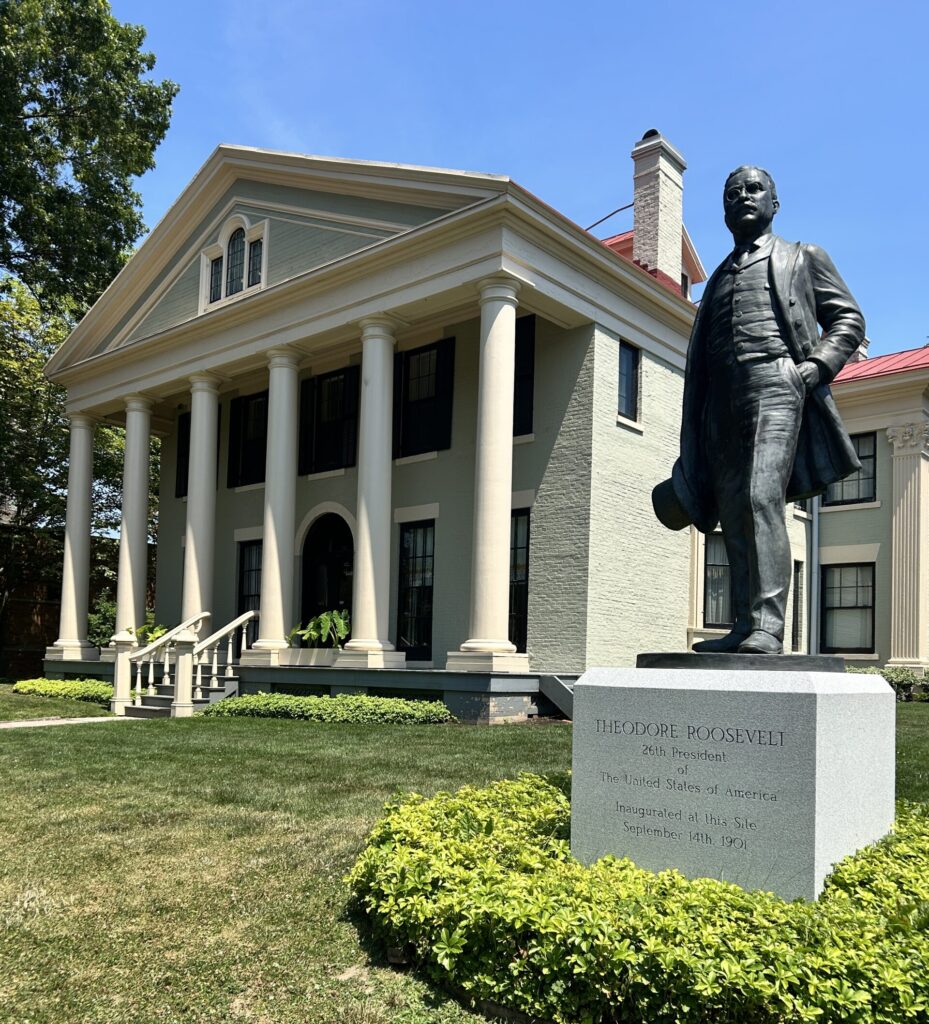
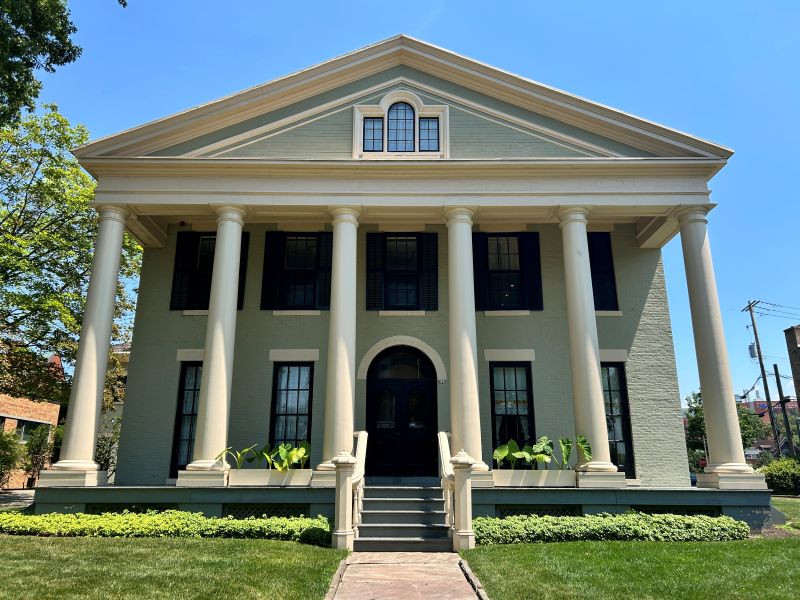
Welcome to the Theodore Roosevelt Inaugural National Historic Site, where one of the most improbable transitions of power unfolded—and where the modern presidency arguably began.
Getting There
Location: 641 Delaware Ave, Buffalo, NY
Transport: Fly into Buffalo Niagara International Airport
Car rental is recommended, though there is a Metro Rail and bus system in town, or ride share services.
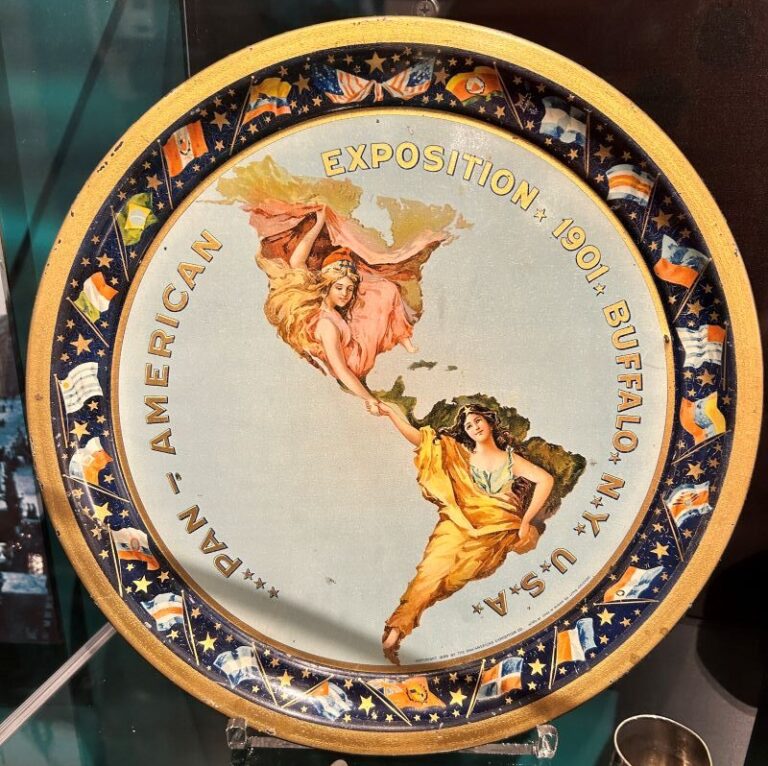
President McKinley visited Buffalo during the 1901 Pan-American Exposition. He used the fair to promote economic expansion and diplomacy.
Sadly, anarchist Leon Czolgosz shot him twice while greeting the public in the Temple of Music. McKinley had limited protection as was customary for the period. As a result, it was easy for the assassin to join the public receiving line and approach the president.
Theodore Roosevelt was hiking in Vermont but rushed to Buffalo when he heard the President was shot. Initially, McKinley seemed to recover, prompting Vice President Theodore Roosevelt to resume his hiking trip in the Adirondacks. But on September 13, Roosevelt received word: McKinley took a turn for the worst.
Roosevelt raced back to Buffalo but did not arrive before McKinley died. He first visited the home where McKinley’s body lay to pay his respects. Unfortunately, builders demolished the home McKinley died in, 1168 Delaware Avenue, in the 1950’s. The Wilcox house, Roosevelt’s inauguration site, nearly faced the same demolition. Fortunately, local residents rallied to preserve it.
A Hasty Inauguration
Officials rushed Roosevelt to the Wilcox home. Six of the eight cabinet members arrived at the home for the event, which was quickly coming together. One example of the haste, Roosevelt had to borrow a suit since he only had the traveling clothes he arrived in.
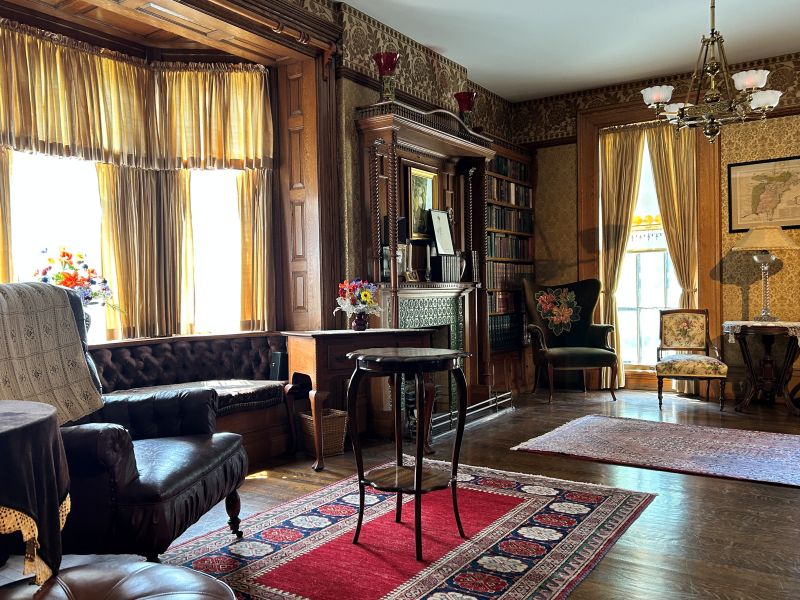
The library was selected for the occasion. Reporters noted that the men assembled stood solemnly with heads bowed and eyes tearing up.
Surprisingly, photographers weren’t allowed to take photos during the ceremony. This was due to the fire hazard of flashes in such a small space.
The round table marks where Roosevelt took the oath in the home's library
Why the Wilcox House?
Government officials constructed the home in the 1830’s as a military garrison following the War of 1812. During that conflict, Buffalo was a key frontier town near the Canadian border. As a result, over 1500 troops were stationed near Buffalo during the war.
Following the war, it became a private residence and in 1883 it became a wedding present for Mary Grace Rumsey. Her father bought it when she married Ansley Wilcox, a prominent Buffalo lawyer.
Wilcox was deeply involved in legal and civic reform, key issues for Roosevelt and his progressive politics. Roosevelt and Wilcox were friends for many years. They served together on the commission to create the Niagara Reservation, one of the earliest protected park areas in the US. As such, Roosevelt knew the house well as he had stayed in the house as guest while in Buffalo.
In the years since the inauguration, the home has undergone extensive restoration to return it to its 1901 appearance. The site has several nice exhibitions on the Fair, the region, and Roosevelt’s presidency.
Introducing President Theodore Roosevelt
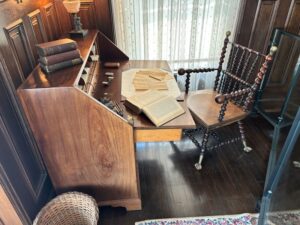
Desk used by President Roosevelt to conduct business in the immediate days after his inauguration
Roosevelt’s Buffalo inauguration marked more than a footnote. Instead, it marked a turning point in presidential history. From this modest parlor, Roosevelt launched a presidency that would redefine American leadership: trust-busting, conservation, and a bold new role on the world stage.
Notably, at just 42, he was the youngest to assume the office. His youth brought vigor and a reformist zeal to the presidency. A champion of the Progressive Era, Roosevelt pushed for the Square Deal, a domestic program focused on consumer protection, corporate regulation, and conservation. He earned the nickname “trust buster” for breaking up monopolies and enforcing the Sherman Antitrust Act.
Roosevelt's Presidency: Reform and Power
Roosevelt’s administration passed landmark legislation like the Pure Food and Drug Act and the Hepburn Act, strengthening federal oversight of industry. He was also a pioneering conservationist and he established national parks, forests, and wildlife refuges, preserving over 200 million acres of public land.
In foreign policy, Roosevelt embraced a bold stance—“Speak softly and carry a big stick”— and expanded American influence through the construction of the Panama Canal. In other examples, he mediated the end of the Russo-Japanese War (for which he won the Nobel Peace Prize), and asserted the Roosevelt Corollary to the Monroe Doctrine.
Roosevelt transformed the presidency into a platform for moral leadership and national stewardship. Visiting the site is more than a history lesson—it’s a chance to stand in the room where the course of a nation shifted. Today it’s a reminder that sometimes, the most powerful moments happen far from the spotlight.
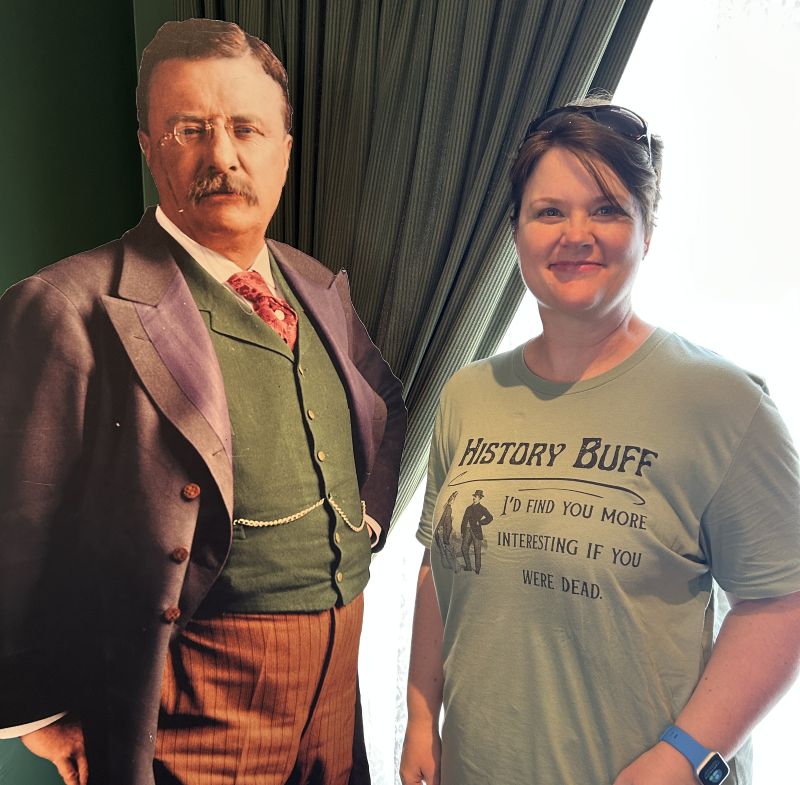
Teddy was 5' 10", just a hair shorter than me, but I'll allow his cutout to be larger than life given the location!
Interested in learning more about this time period in history? Here’s a brief primer of the Modern period to put this post in context!
Original historic designs now available in my Etsy shop: EpochApparelDesigns
“Bully” was an oft-used expression by Theodore Roosevelt meaning ‘super’ or ‘wonderful’. He called his platform his “bully pulpit” and felt he needed to utilize the spotlight of his inauguration and presidency to advance the Progressive cause.